
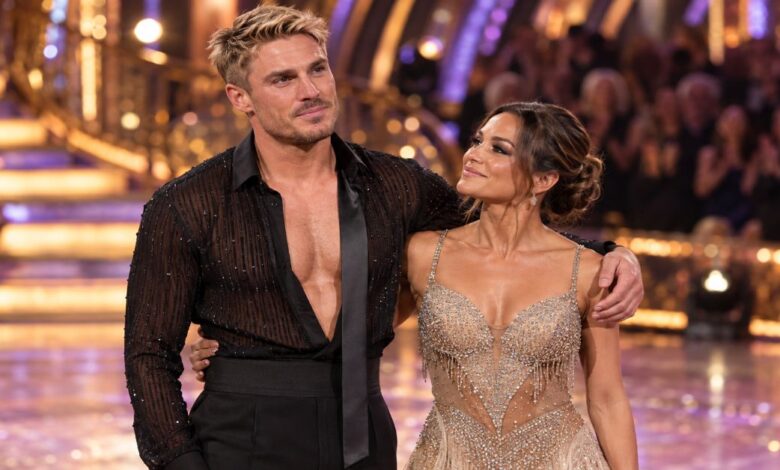
Chris Appleton Strictly Come Dancing lasted just two competitive performances in 2026, yet the celebrity hairstylist’s departure tells a bigger story than a low score. On 4 October, he and professional partner Amy Dowden became the first couple eliminated after losing a Movie Week dance-off to Jaime Winstone and Carlos Gu. It was a clear television result, but a less clear measure of what he had set out to do.
Appleton had spent years working on the appearance of some of the most photographed people in entertainment. He knew how to prepare a look for a camera, a red carpet or a demanding client. On Strictly, however, the camera was trained on his own footwork, timing and uncertainty. That reversal—not celebrity name recognition—is the interesting part of his brief run.
Across the first two live weeks, he scored 16 for a tango and 17 for a Baywatch-themed cha-cha-cha. Those numbers put him in difficulty when the public vote began. They do not explain why he agreed to enter the ballroom in the first place, or what he learned while there.
After leaving, Appleton talked openly about nerves and the fact that he had managed to get through the performances. Dowden, too, emphasised the confidence she had seen growing in him. Their descriptions give a more useful way to understand two weeks of television: not as proof of natural talent, but as an unusually public attempt to become a beginner again.
Who Is Chris Appleton Outside the Ballroom?
Christopher Appleton is an English celebrity hairstylist from Leicester who built an international career across salon work, fashion shoots and entertainment. His clients have included Kim Kardashian, Jennifer Lopez and Ariana Grande. The familiar shorthand—Hollywood hairstylist—conceals years of training that started well before fame.
From a Leicester salon to celebrity clients
In an interview with Professional Hairdresser, Appleton said he began working in a salon at 13. He named Georges Hairdressing in Leicester as an early professional home and described opportunities to train in London and bring new techniques back to the salon. This matters because his career was built in a craft where repetition, technical feedback and patient practice are normal, even when the finished result looks effortless.
His early recognition also deserves precision. Contemporary British Hairdressing Awards records list Christopher Appleton of Georges Hairdressing, Leicester, as the 2010 Eastern Hairdresser of the Year. Some later profiles use other descriptions of his early honours; the contemporary awards list is the stronger evidence for that specific title.
Working with major performers brought demands of its own: speed, reliability, styling under bright lights and an ability to make somebody else feel camera-ready. Those skills made him successful behind the scenes. Ballroom dancing, by contrast, placed his own movement and confidence under direct judgment.
Why success in hair did not guarantee success in dance
Precision in styling and precision in partner dancing are not interchangeable. A hairstylist can adjust a result before anyone sees it; a live dancer cannot stop the music to reset a missed beat. A celebrity professional may be accustomed to public attention without being accustomed to public scoring. That difference explains why someone skilled and confident at work can still find Strictly frightening.
Chris Appleton’s Strictly Come Dancing Results
The performance record is short enough to show without exaggeration. These are the two competitive routines Appleton performed with Dowden before his elimination.
| Stage | Dance and music | Judges’ score | Outcome |
| Week 1, 26 Sept. | Tango — “No Roots” by Alice Merton | 16 / 40 | Continued; no first-week elimination |
| Movie Week, 3 Oct. | Cha-cha-cha — Baywatch theme, “I’ll Be Ready” | 17 / 40 | Entered first public-vote results |
| Results, 4 Oct. | Cha-cha-cha repeated in dance-off | 33 combined across two weeks | Eliminated against Jaime Winstone and Carlos Gu |
The tango: a difficult public introduction
Appleton’s opening tango received 16 points. It showed where the judges placed his first attempt relative to other couples, but it did not end his participation. In the 2026 format, the first live week had no public elimination, giving every celebrity another chance to perform before the first result.
That timing matters. A viewer who sees “16 points” and “first eliminated” might assume the first performance alone sealed his fate. It did not. The competition’s early design meant his second routine and the public vote both mattered.
Movie Week: a small improvement, not a rescue
For Movie Week, Appleton and Dowden performed a Baywatch-inspired cha-cha-cha to the show’s theme, “I’ll Be Ready.” The routine scored 17, one point above his tango. A one-point increase is not enough evidence for a dramatic technical breakthrough, but it does show that the two performances were scored separately and that his final judged total was 33.
The cha-cha-cha also demanded a different presentation from the tango. Movie Week placed a recognisable television reference around a Latin routine. The costumes and theme could make it entertaining, but they did not erase the timing, hip action and coordination the judges expected.
Why Chris Appleton Was Eliminated
Appleton was eliminated because he and Amy Dowden reached the bottom two once the judges’ first-two-week scores were combined with the first public vote, then lost the dance-off to Jaime Winstone and Carlos Gu. His 17-point Movie Week score was not by itself the elimination rule.
Appleton and Dowden repeated their cha-cha-cha; Winstone and Gu repeated theirs. Motsi Mabuse, Anton Du Beke and Shirley Ballas voted to save Winstone and Gu. Craig Revel Horwood said he would have made the same choice, although his vote was not needed to determine the outcome.
| Question | What the evidence supports | What it does not establish |
| Were his scores low? | Yes: 16 and 17, totaling 33. | That a single dance score automatically eliminated him. |
| Did viewers have a say? | Yes: the public vote was incorporated after Movie Week. | A precise vote count or percentage, which was not public. |
| Was the dance-off close? | The judges unanimously favoured Winstone and Gu. | That Appleton had no ability to improve with more time. |
| Did he win his personal challenge? | He said he was proud he had performed despite nerves. | That every viewer or judge defined success the same way. |
A crucial distinction follows: Strictly is both a judged dance competition and a public vote. Its verdict decides who stays in the programme; it cannot fully assess whether a participant has overcome fear or learned something useful. Both outcomes can be true at once: the judges preferred the other couple, and Appleton felt the experience mattered.
The Jill Halfpenny Connection: A Dream Before Hollywood
The most revealing background detail is Appleton’s familiarity with Strictly long before joining its cast. In a pre-series Q&A, asked which past routine he would like to attempt, he chose Jill Halfpenny and Darren Bennett’s 2004 jive. His choice was specific: a celebrated dance from the programme’s early history, not a vague reference to wanting television exposure.
That answer changes the shape of the story. Appleton had a reference point for what exciting dancing looked like. He also had a clear gap between the polished routine he admired and what he could reasonably do after limited training. Admiration, however, is not proof that he had followed a particular childhood dance-training path. Reports that he previously took lessons and quit because he felt inadequate should not be presented as established without a reliable on-record source.
He did not need a Glitterball to have a reason to join
At the Attitude Awards after his exit, Appleton explained that winning had not been his aim. He wanted to see if he could do a Saturday-night performance, and he was proud that he had. That statement is his own account of motivation, rather than a claim that the competition’s result was unimportant.
There is an important difference between joining without a win-at-all-costs attitude and not caring about performance. Appleton also expressed regret that he could not go further with Dowden. People can accept an outcome and still wish it had been different.
Amy Dowden’s Role in a Two-Week Partnership
A professional partner on Strictly is not simply the person dancing next to a celebrity. Dowden also had to teach choreography, judge what Appleton could handle, prepare him for live performance and respond to the judges’ feedback. Two weeks allowed little time for the familiar long-season story in which a hesitant contestant gradually becomes polished.
Speaking on It Takes Two after their exit, Dowden said she had seen Appleton’s confidence grow, and that she was disappointed they did not have more time. Appleton described going on stage while shaking and looking to her for reassurance. Those are grounded observations from the participants, not a claim that audiences witnessed a completed transformation.
Dowden’s disappointment belongs in the story as well. A short partnership ends opportunities for the professional dancer as much as for the celebrity, but it does not justify blaming the teacher for the public vote or inventing an alternative result. Her reflections support a narrower, more human conclusion: they had developed trust quickly and wanted longer to work together.
What Two Weeks of Training Can—and Cannot—Prove
Appleton’s reported physical changes added another headline after the elimination. On 15 October, entertainment coverage described his claim that he had lost about 30 pounds during the Strictly training period. It is a self-reported figure, not a medically validated measurement or a recommendation for viewers to imitate the training workload.
Treating weight loss as the chief achievement would miss the more distinctive part of his story. The reported change may show how demanding rehearsals felt to him, but body weight cannot directly measure dancing skill, confidence or wellbeing. The public statements from Appleton and Dowden speak more clearly to the emotional impact.
Three Lessons the Scoreboard Misses
A professional expert can still be a novice
Appleton’s reputation was made through years of specialist practice. Strictly removed the advantage of that expertise while keeping the pressure of being recognisable. The interesting risk was not that he might be bad at dancing; it was that viewers could watch him be bad at something before he had time to improve.
A public failure is not the same as a failed experiment
His participation had two goals that should not be conflated: advancing in a televised contest and proving he could perform despite nerves. The first ended quickly. By his own account, the second was achieved. Readers need not agree with his definition of success, but they should use the stated goal rather than silently replace it with the trophy.
Early exits leave more uncertainty than evidence
The first elimination can attract a memorable label, yet it reveals little about the rate at which a contestant might have learned. His scores moved from 16 to 17, a difference too small to support a confident growth forecast. A longer run might have improved technique, or it might not. The programme cannot test a counterfactual it never televised.
Career and Competition: Different Measures of Success
Putting Appleton’s established career next to his Strictly appearance shows how the definition of competence changes with the setting. The comparison is useful precisely because one outcome was built over years and the other judged almost immediately.
| Dimension | Celebrity hairstyling | Strictly 2026 |
| Preparation | Years of salon and editorial practice | A short rehearsal period before live routines |
| Core task | Design and deliver a look for another person | Perform choreographed movement in a partnership |
| Feedback | Clients, collaborators and creative briefs | Judges’ scores and audience voting |
| Visible outcome | Long-standing work with major performers | Two scored dances and first elimination |
| Reason to continue | Professional mastery and new projects | Personal challenge, confidence and the desire to improve |
The Future of Chris Appleton After Strictly in 2027
There is no verified announcement, as of 15 October 2026, that Appleton will return to Strictly, join a tour or take on another televised dance programme in 2027. Claims about a confirmed comeback would be premature. His likely public career remains connected to hairstyling, beauty work, media appearances and projects arising from his existing profile, but specific future plans require direct confirmation.
The more meaningful question is whether he continues dancing in any form. His comments suggest the experience changed how he thinks about his ability to perform while nervous. That does not establish a training plan. If he posts a documented follow-up, it would give readers a real continuation of the story without needing to manufacture a television sequel.
Strictly’s current season is also still underway. That makes contemporary references to the 2026 contest time-sensitive: the identity of the eventual winner is unknown at the publication date, while Appleton’s own elimination record is settled. The article should retain its explicit October 2026 date so it does not become misleading as the season develops.
Key Takeaways
- Appleton and Dowden left on 4 October 2026 after two judged performances totaling 33 points.
- The elimination followed combined early scores, a public vote and a judges’ dance-off decision; no single number tells the entire story.
- His professional celebrity image made becoming a visible dance beginner an unusual risk.
- His reference to Jill Halfpenny’s 2004 jive shows a specific connection to Strictly’s history.
- Dowden described growing confidence, while Appleton said his purpose was to face the challenge rather than secure the trophy.
- The reported 30-pound loss should remain an attributed personal claim, not a health lesson.
- Unverified details about earlier dance lessons or 2027 plans should stay out of factual summaries.
Conclusion: The Short Run That Revealed Something Else
Chris Appleton did not last long on Strictly Come Dancing. The judges’ scores, the public vote and the dance-off all produced a legitimate competitive result: he and Amy Dowden were the first pair to leave the 2026 series. Pretending that the elimination did not matter would be as misleading as treating it as the entire story.
What makes his appearance worth revisiting is the change in perspective. A Leicester stylist who learned to build confidence through craft found himself facing a task he could not master on demand. His experience was unpolished, publicly judged and short. Yet his account of walking onto the floor despite nerves suggests he had set himself a challenge that could be met without lifting a trophy.
There is no need to inflate two performances into a dramatic sporting achievement. The stronger reading is quieter and more credible: success in one field offers no exemption from fear in another. Appleton went out early, but he made the attempt in front of millions. That is a different outcome from winning—and, in the terms he later used, a meaningful one.
Frequently Asked Questions
Who is Chris Appleton on Strictly Come Dancing?
Chris Appleton is a Leicester-born British celebrity hairstylist known for working with major entertainers, including Kim Kardashian and Jennifer Lopez. He joined the 2026 series as a celebrity contestant rather than a professional dancer.
Who was Chris Appleton’s Strictly partner?
His professional partner was Amy Dowden. They performed together for the first two scored shows and were eliminated following the 4 October 2026 results programme.
What dances did Chris Appleton perform on Strictly?
He performed a tango to Alice Merton’s “No Roots” in Week 1, scoring 16, and a Baywatch-themed cha-cha-cha to “I’ll Be Ready” in Movie Week, scoring 17.
Why was Chris Appleton eliminated from Strictly Come Dancing?
Appleton and Dowden entered the bottom two after the combined judges’ scores and public vote. The judges saved Jaime Winstone and Carlos Gu after both couples repeated their Movie Week routines in a dance-off.
How many points did Chris Appleton score?
He received 33 judges’ points across his two competitive dances: 16 for the Week 1 tango and 17 for the Movie Week cha-cha-cha.
Did Chris Appleton lose weight during Strictly?
Appleton reportedly said he lost approximately 30 pounds during the dance-training period. This is an attributed personal report and should not be taken as a typical or recommended effect of dance training.
Did Chris Appleton expect to win Strictly?
After his exit, he said winning was not the goal. He wanted to challenge himself by performing on a Saturday night and said he was proud that he had done so.
Methodology and Editorial Notes
This article was prepared using dated reporting from October 2026, the participants’ post-elimination comments, a pre-series contestant interview, a firsthand professional interview with Appleton and contemporary hairdressing award records. Results, points and judge decisions were checked against more than one independent account. Interpretations about confidence and career identity are editorial analysis, not clinical conclusions.
Limitations: no verified public vote totals were available. The claim that Appleton quit earlier dance lessons and descriptions of a different 2010 award have not been independently substantiated and have been excluded. No relevant live article URLs on fishaudios.com could be verified during research, so no internal links were inserted; the editor should add relevant verified internal links if they are published. This draft requires human editorial review before publication.
AI disclosure — publication checklist: This article was drafted with AI assistance. Human editorial review and independent verification of every linked claim must be completed before publishing. Do not represent that human review has already occurred.
References
Huggett, P. (2026, October). Chris Appleton says winning was never the goal. London Standard.
Professional Hairdresser. (n.d.). Hooker & Young: In conversation with Christopher Appleton.
Mensah, K. (2026, October 4). Who left Strictly 2026? Radio Times.
Nugent, A. (2026, October 6). Strictly pro Amy Dowden says she’s gutted. The Independent.
Carter, R. (2026, October 15). Chris Appleton reveals reported weight loss. Entertainment Daily.
Strictly Come Dancing 2026 contestant Q&A. (2026, September). DVDfever.