
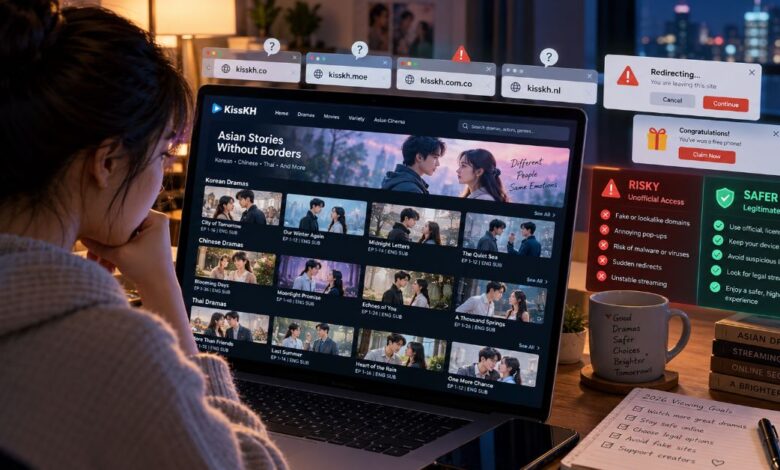
KissKH is associated with free online access to Asian dramas and movies, but the biggest question in 2026 is not which address loads today: it is whether the page behind that address is trustworthy, licensed and accountable. Search results reveal several domains using similar branding, and their public claims do not establish a single verified operator.
A viewer may start with a simple goal: find an English-subtitled Korean drama, a Chinese historical series or a Thai romance. The search can lead to multiple pages with matching titles, familiar thumbnails and a large play button. Yet identical branding says little about where the stream originates or what a click may do. One domain can show an embedded third-party player while another asks visitors to install a mobile application. Those are materially different experiences.
The attraction is understandable. Licensed libraries can be fragmented by region, and subscriptions add up when a show is split across services. Netflix, for example, explains that content rights differ by territory and may expire. But gaps in availability do not establish permission for an unrelated website to distribute a programme.
This guide separates what can be checked from what remains uncertain. It explains the domain problem, looks at advertising and download warnings, compares reputable viewing options and provides a safer way to search for a specific show. It does not nominate an unverified “official” mirror or pretend that one risk rating covers every site using this name.
A streaming name spread across different domains
The KissKH label appears across several web addresses. Pages associated with these addresses variously describe themselves as streaming directories, third-party embedding sites or drama communities. Similar appearance and shared wording do not prove common ownership. Even an apparently polished copyright policy can be copied or published by an unrelated operator.
A domain comparison reveals a verification gap
The following examples are evidence of naming and claims, not endorsements or verified operator relationships. The status of each destination can change quickly.
| Observed domain | Publicly visible claim or evidence | What remains unverified |
| kisskh.co | Historical KissKH domain; older terms page and third-party traffic records | Current operator, present service status and licensing |
| kisskh.moe | Publishes a 2026 DMCA page saying media is supplied by third parties | Whether its operator is connected with other domains |
| kisskh.com.co | Publishes 2026 terms stating it links to embedded third-party media | Specific rights for individual shows |
| kisskhweb.org | Publishes an about page and copyright policy | Independent proof of official status or catalogue rights |
| kisskh.nl | Named in a July 2026 ScamAdviser safety article | Whether it is controlled by the same party as earlier domains |
The central finding is not that every listed domain is malicious. It is that the evidence available does not justify telling readers to trust one domain merely because its name looks familiar. That distinction matters for searches such as “official website,” “new link” and “not working.”
Why the official-site question is harder than it looks
A convincing operator identity normally has more than a logo: consistent legal contact information, a clear publisher identity, verifiable rights or distribution partners, and a documented app listing when downloads are offered. A notice that says “we do not host files” describes part of a technical setup; it does not independently establish who has permission to make those files accessible.
How the viewing experience actually works
Streaming directories often place a title catalogue in one system and stream playback in another. A page can display a poster, episode list and subtitles, while a third-party player loads from a different infrastructure provider. This separation makes content discovery convenient, but it also complicates security and accountability.
The difference between a catalogue and a video host
A catalogue lists titles, episode information and links. A host stores or transmits the actual video. An embed lets the catalogue show a player supplied elsewhere. If playback fails, the root problem may be the host, a removed video, an expired token, regional restrictions or a browser incompatibility—not necessarily the page the viewer first visited.
For the reader, that means there are two trust questions. Can the site itself be trusted with browser access and personal data? And can the external player be trusted to deliver content without unwanted redirects or downloads? A clean-looking landing page cannot answer the second question.
Free access comes with trade-offs
The apparent price may be zero, yet the user still spends attention, bandwidth and time. Aggressive advertising can make an episode frustrating to watch. A redirect or fake “update your player” prompt can impose a much higher cost if it leads to credential theft or an unwanted installation. Risk varies by domain, browser and ad network; it should not be reduced to a blanket claim that every visit causes infection.
Security signals that matter more than a safety score
A third-party scanner report from June 2026 described a moderate-risk assessment for kisskh.co, with two engines flagging that URL as suspicious in a saved scan. Such a result is a warning signal, not proof that every domain using the name is infected. Scores are snapshots and can miss fresh redirects, new domains and content loaded after the original page.
Google’s browser-security guidance identifies persistent pop-ups, unfamiliar redirects, unwanted extensions and fake virus alerts as indicators that require attention. These signals are more actionable for a visitor than a single numeric trust score.
For practical remediation, see Google Chrome’s instructions for removing unwanted ads, pop-ups and malware (Google, n.d.).
A warning-sign checklist for viewers
| Warning sign | Why it matters | Reasonable response |
| Install a special player, extension or APK | Unrelated code may gain access to your device | Do not install; use the official store for legitimate apps |
| Enter a reused password to unlock video | Credentials may be harvested | Close the page; change reused credentials if entered |
| Allow browser notifications to continue | Persistent spam or deceptive prompts may follow | Deny or revoke notification permission |
| Disable browser security or antivirus | Removes a layer of protection | Do not bypass the warning |
| Enter payment details on a confusing mirror | Operator and payment handling are unclear | Verify the merchant independently before paying |
HTTPS is helpful because it protects data in transit between a browser and a domain, but it cannot prove the owner is reputable or that a video is licensed. Similarly, a VPN may change the network path and apparent location, but it does not validate site scripts, apps or licensing permissions.
If you already clicked a suspicious link
Close unexpected tabs without agreeing to a download, revoke notifications for the domain, check browser extensions and review installed applications. If you entered a password, change it from the actual service’s website and enable multifactor authentication where supported. If you installed unknown software, scan the device using trusted security tools and remove unfamiliar applications. Bank or payment details require a separate, timely check with the account provider.
Copyright, embeds and the limits of the DMCA statement
One recurring claim is that a site merely embeds streams and does not store files. That may describe how a page works, but it does not settle the permission question. Copyright authorization depends on the work, rightsholder, territory and type of distribution. Hosting a file and linking to an infringing stream are different technical acts; neither becomes automatically licensed because a site publishes takedown instructions.
Publicly visible DMCA or copyright-policy pages linked with KissKH-branded domains explain how complaints may be submitted. They are evidence of what those sites say about their practices, not independent certification of the legality of each title. Nor is it accurate to announce that every individual viewer is breaking the law; legal treatment can vary substantially by jurisdiction and behaviour.
Why the same show appears in one country but not another
Licensed platforms negotiate country-by-country rights. Netflix explicitly notes that films and series can be available only in selected territories or for limited periods. A show missing from a subscription catalogue may therefore reflect a licensing boundary rather than a technical failure.
Netflix’s own explanation of how it licenses titles makes this regional distinction clear (Netflix, n.d.).
Licensed choices for Asian drama fans
The more useful question is not “what is an exact clone?” but “which authorized service carries the particular programme where I live?” Drama catalogues can shift; any platform comparison must therefore focus on what can be checked rather than promising that a given show is always available.
| Option | What viewers may find | Important limitation |
| Rakuten Viki | Korean and other Asian series; subtitle-focused viewing | Free and paid access vary by title and region |
| Netflix | Originals and licensed Asian drama selections | Membership and regional rights affect the catalogue |
| iQIYI | Chinese-language shows and Asian drama programming | VIP access and regional availability vary |
| WeTV | Regional drama and entertainment programming | Catalogue and premium episodes vary by market |
| Official broadcasters / studios | Some episodes, clips and programmes on authorized channels | Not every series or episode is free or internationally available |
No single service is an exact replacement for an unlicensed collection that aggregates material from multiple rightsholders. That is an important trade-off: legitimate platforms may have cleaner playback and clearer payment terms, but they cannot always supply every desired title in one place.
A practical title-first search workflow
Start with the exact drama title and release year, especially when translations are similar. Search the official distributor or studio, then a well-known licensed service. Confirm that the page lists the correct season and episode, that subtitles are offered in the required language, and that playback is authorized in your country. For hard-to-find series, a title database can help identify alternate names, but a listing or community page should not be confused with proof of streaming rights.
This approach prevents a common trap: chasing whichever domain ranks highest for a general site name, rather than locating a particular work on a platform that can legitimately deliver it. It also makes the decision clearer when a show is simply unavailable in a region.
Why a “not working” search can make the problem worse
When an episode stops loading, users often search for a working mirror. That is precisely when lookalike pages can benefit from urgency. Browser errors, deleted embeds and domain changes produce similar symptoms, so switching to the first new address may create additional exposure without solving the original issue.
Playback problems versus site problems
If only one episode fails, the embedded file may have been removed. If the entire domain fails, DNS, hosting or blocking may be involved. If the page opens but repeatedly redirects, the issue may be advertising or browser compromise. None of these symptoms independently proves who controls a replacement site. Avoid installing browser extensions or unknown mobile packages in an attempt to repair an unreliable player.
The Future of KissKH in 2027
There is no verified public roadmap establishing where every KissKH-branded domain will operate in 2027, whether a stable app will emerge or whether any site will obtain new distribution rights. Predictions about a definitive successor would be speculative. What is visible now, however, is a recurring structural problem: searchers want one dependable destination, while multiple similarly named websites make it difficult to attribute responsibility.
The larger streaming industry faces a different challenge. Rights continue to be negotiated by market, creating gaps that aggregators can exploit in search results. As long as licensed catalogues remain fragmented, some viewers will look for broad, free libraries. Yet moving between domains does not resolve copyright, security or identity questions.
Browser protections and search reputation tools may improve warnings about some threats, but they do not establish lawful access to copyrighted programmes. By 2027, the strongest consumer habit will likely remain title-first verification: identify the exact programme, locate its rights-bearing distributor and decide whether the available offer suits the viewer’s budget. This is a practical scenario, not a prediction based on a confirmed brand announcement.
Key Takeaways
- A brand name repeated across domains is not evidence of one accountable company.
- Embedded streaming separates the catalogue from the player, creating more than one trust boundary.
- A safety scan is a dated clue, not a permanent verdict.
- An HTTPS padlock and a posted DMCA policy cannot prove distribution rights.
- The lowest-friction way to find a particular drama is to search by title and territory.
- Licensed services have catalogue limits, but give users clearer publisher, payment and support channels.
Conclusion
The appeal of free Asian drama streaming is easy to see. Viewers want simple access, readable subtitles and uninterrupted episodes, not a complicated investigation into domains and video hosts. But the name of a streaming site is not a substitute for an identifiable operator. When several websites use similar labels and make overlapping claims, recommending one as the permanent official address would give a level of certainty the evidence does not support.
The better standard is modest and verifiable. Avoid unnecessary downloads, distrust urgent login and payment prompts, and remember that a polished copyright policy does not prove a licensed catalogue. Check a specific title against a known service in the country where it will be viewed. That method may reveal the inconvenience of subscriptions and regional gaps, but it also makes the actual trade-offs visible. For KissKH in 2026, that clarity is more useful than a long list of unverified replacement links.
Frequently Asked Questions
Is KissKH a free streaming site?
The name is commonly used by websites advertising free Asian dramas and films. However, different domains may have different features, operators and practices. Free access does not establish that all streams are authorized or safe.
Which KissKH website is official in 2026?
The research reviewed multiple branded domains but did not establish a single independently verified official operator or permanent address. Treat claims of official status cautiously until they can be corroborated outside the site itself.
Is the KissKH app safe to download?
Safety cannot be established from the brand name alone. Avoid APK files delivered through ads, mirrors or unknown download pages. Check developer identity and permissions in an official app marketplace before considering installation.
Why is the KissKH website not working?
Possible causes include domain changes, hosting problems, removed third-party embeds, browser blocking or country-level restrictions. These explanations require case-specific evidence. An outage does not make an unverified mirror trustworthy.
Can a VPN make unofficial streaming safe?
No. A VPN may alter the network route or apparent location, but it does not verify embedded scripts, downloaded apps, content licenses or a site’s handling of personal information.
Where can I watch Korean and Chinese dramas legally?
Check services such as Rakuten Viki, Netflix, iQIYI or WeTV, along with official broadcaster channels. Look up the exact series and confirm regional availability, subtitles and whether a subscription is required.
Does a DMCA notice make streaming legal?
No. A takedown notice describes a complaint process, not proof that the platform has permission for every programme it displays. Rights are specific to titles, territories and uses.
Methodology and limitations
This assessment used public domain-policy pages from sites carrying the KissKH name, third-party security reports, search-result comparisons, Google Chrome’s browser-safety documentation and Netflix’s licensing explanation. The comparison reviewed visible search results and competing coverage, not a controlled live test of every video host or domain. No account was created, app was installed or copyrighted playback tested. Statements from site operators are identified as their own claims rather than independently verified facts.
An attempt to access the fishaudios.com homepage and XML sitemap through the available web tools failed, and domain-restricted searches did not surface verifiable live article URLs. Consequently, no internal links have been fabricated; the suggested placements below should be populated only after the publisher verifies published destination pages. This document is an AI-assisted draft requiring actual human review before publication. The required editorial disclosure should be added as a factual statement only once all described editorial and source-verification steps have occurred.
Editorial disclosure to publish after completion of human verification: “This article was drafted with AI assistance and reviewed by a human editor before publishing. All data, citations, and claims have been independently verified against primary sources.”
References (APA-style)
Google. (n.d.). Remove unwanted ads, pop-ups & malware. Google Chrome Help.
Netflix. (n.d.). How Netflix licenses TV shows and movies. Netflix Help Center.
Kisskh.moe. (2026, March 23). DMCA.
Kisskh.com.co. (2026, March). Terms of service.
ScamAdviser. (2026, July 23). KissKH | Kisskh.nl review: Is it safe or a risky streaming site?
MalwareTips. (2026, June 28). Is kisskh.co safe? [Saved scan].