
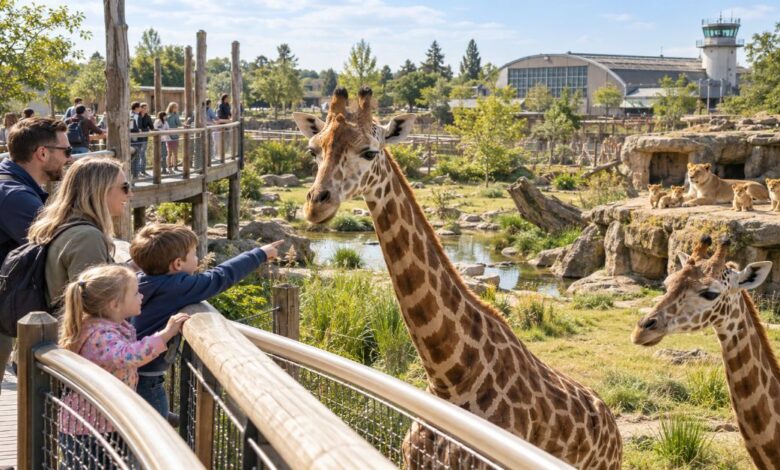
Blackpool Zoo is a family wildlife attraction built on a former airport, and its most compelling 2026 story goes well beyond a list of animals: new lion cubs, an expanded giraffe habitat and a living reminder of Blackpool’s aviation past. For visitors, the best approach is to allow four to five hours, start with priority habitats and keep the plan flexible around animal welfare and the weather.
The setting gives the place an unusual identity. The site opened as Blackpool Municipal Airport in 1931, hosted RAF activity during the Second World War and later became a zoo. Part of that history survives in structures now used for animal care and education. The transformation is more meaningful than a curiosity: it explains why this is a destination that has developed in stages rather than a single, purpose-built safari landscape.
There is plenty that has changed recently. Giraffe Heights gained the Kidepo Trail in May 2026. A three-cub African lion litter followed in July, while rare king colobus infants were reported in February. Yet the question that matters to a paying visitor is practical: can a family see the highlights at a reasonable pace, in uncertain Lancashire weather, without wasting money on extras?
This guide combines the documented changes with a suggested route, cost considerations, access details and a clear distinction between things visitors can expect and things no zoo can promise, such as an animal being on view at a specific minute. It is researched guidance, not a claim of a first-hand visit.
At a glance: the trip to plan, not the perfect trip to imagine
| Decision | Practical answer | What to verify |
| Location | East Park Drive, Blackpool FY3 8PP | Travel route and bus service |
| Time needed | Allow roughly 4–5 hours as a planning estimate | Talk schedule and closing time |
| Best starting point | Arrive near opening; choose two must-see species | Daily habitat notices |
| With toddlers | Build in meals, toilets and one play break | Pushchair and changing facilities |
| Wet weather | Use indoor viewing and cafés as pauses | Which habitats are open |
| Access | Mostly level grounds, with varied path surfaces | Accessibility map and equipment hire |
From Blackpool Municipal Airport to animal hospital
The 1931 airfield that outlived its aircraft
According to the zoo’s official history, Blackpool Municipal Airport opened here in 1931. During the Second World War, the RAF used the site for parachute training; hangars were built for work on Wellington bombers. Postwar plans moved away from aircraft and eventually toward a major leisure attraction. An ambitious 140-acre zoo-and-safari proposal was never fully delivered, with the original development much smaller.
The aviation story is not erased: the zoo identifies a former hangar and air-traffic-control building as facilities now serving its animal hospital and Education Academy. These are working adaptations, not museum rooms to assume are freely accessible. Their real significance is the continuity of a public site that has been repurposed to meet different community needs.
Opening day was unmistakably Blackpool
On 6 July 1972, the television presenter Johnny Morris officially opened the new zoo while riding an elephant; the mayor followed in a Rolls-Royce. It was theatrical, fitting the resort’s entertainment culture. Today, the stronger story is the shift from spectacle toward managed habitats, breeding programmes and conservation education. The zoo’s 2018 Project Elephant Base Camp, including a substantial indoor elephant house, shows how much has changed since that opening.
The dates and surviving buildings are documented in the zoo’s official history.
What actually changed in 2026
Kidepo Trail: more space, not just a new viewing platform
Opened in May 2026, the £500,000 Kidepo Trail redevelopment at Giraffe Heights tripled the external giraffe area. The zoo describes an extended walkway, lookout points, educational interpretation and an area shared with sitatunga. Its name refers to Uganda’s Kidepo Valley and the Nubian giraffe conservation work the zoo supports through the Giraffe Conservation Foundation. The improvement matters from two directions: increased habitat choice for animals and more ways for visitors to observe without crowding one spot.
Three lion cubs, with a sensible caveat
The zoo announced that Hira gave birth to three African lion cubs on 26 July 2026, the first cubs born there since 2015. Its announcement also described temporary viewing restrictions to give the new family privacy. A birth is not a guarantee of a public sighting: access, animal care and the animals’ own behaviour take priority. Treat the cubs as a possible highlight rather than the only reason for the trip.
Rare monkeys and an elephant calf’s first year
Three king colobus infants were born on 16 January, 24 January and 4 February 2026, according to the zoo. Their arrival followed the 2025 introduction of Bert through an EAZA breeding programme, bringing the group to eight at the time of the announcement. The zoo also marked Asian elephant Zaiya’s first birthday in September 2026 and reported the intensive feeding and care she needed after difficulty suckling. These are more revealing stories of animal management than a simple “new babies” headline.
| 2026 update | Verified timing | Visitor implication |
| Kidepo Trail | Opened May 2026 | Allow time for the enlarged giraffe viewing trail |
| King colobus infants | January–February births, announced 12 February | Look for infant behaviour; visibility varies |
| African lion cubs | Born 26 July; announced 30 July | Follow enclosure access notices |
| Zaiya the elephant | Turned one on 2 September | Understand care needs; avoid expecting staged encounters |
The strongest habitats to prioritise
Elephants and giraffes: two very different viewing experiences
Project Elephant Base Camp deserves time because indoor and outdoor options can make observation possible in different conditions. Giraffe Heights is a strong second anchor because the expanded trail invites a slower walk and makes the conservation connection visible. Neither site guarantees that animals will be close to the fence: large, complex habitats are supposed to give them choice.
Great apes, big cats and quieter discoveries
Gorilla and orangutan habitats reward patient watching rather than a rushed photograph. Big cats can rest for long periods, especially when visitors expect action. Lemurs, smaller primates and birds add variety between the major headline enclosures. For children, shifting between high-profile animals and smaller habitats can keep curiosity alive without turning the day into a checklist.
One useful test: if an animal is out of sight, read the conservation interpretation or revisit later instead of assuming the enclosure is empty. A good zoo day involves watching ordinary animal behaviour, not demanding a performance.
A four-to-five-hour route for families
This is a suggested sequence, not a surveyed walking map. Check the official zoo map and talk times on arrival; take the nearest sensible path and reverse stops if a feeding talk or habitat notice changes the plan.
| Approximate time | Focus | Why this works |
| 10:00–10:40 | Start with a priority habitat: big cats or elephants | Use fresh attention and avoid backtracking |
| 10:40–11:35 | Giraffe Heights / Kidepo Trail | Leave room for the expanded trail and interpretation |
| 11:35–12:20 | Gorillas, orangutans or smaller primates | Mix familiar favourites with close observation |
| 12:20–13:00 | Lunch, toilets and a break | Reduce tiredness before the afternoon |
| 13:00–14:10 | Sea lions, birds, lemurs or a scheduled talk | Let programme times determine the order |
| 14:10–15:00 | Revisit missed animals; exit at your own pace | A second viewing chance beats rushing |
For a toddler, remove stops rather than speed up
Choose two “must-sees”, one quiet rest and a predictable lunch time. Use the zoo’s baby-changing and stroller information before travel. Families with school-age children can add more interpretation and talks; adult visitors may prefer spending longer at fewer habitats. The best route is not the one that claims to see every species.
Rain changes the rhythm, not the basic plan
A shower is not necessarily a reason to cancel, but this is principally an outdoor attraction. Take waterproof layers and use covered or indoor viewing areas as respite, not as a claim that all the zoo is sheltered. In persistent heavy rain, reduce the intended visit length and prioritise species with indoor viewing, the main café and exhibits open that day.
Tickets, parking, accessibility and the real total
The official ticket page uses flexible pricing and states that advance online prices may be lower than gate prices. On the page checked for this article, adult tickets were shown from £21.99 online versus £24.99 at the gate, and a family-of-four ticket from £71.99 online versus £80.99 at the gate. These are advertised starting prices, not promises for a particular date. Check the calendar immediately before purchase.
For illustration, the starting family ticket of £71.99 plus £4.50 parking would make £76.49 before food, transport, souvenirs or paid experiences. This is a simple calculation, not an independently quoted family package. It demonstrates why the entry headline is not the complete outing cost. A packed lunch can improve predictability; the zoo’s access information describes picnic tables and dining options.
The zoo describes its grounds as generally accessible but with varied surfaces, and offers accessible toilets, a Changing Places facility, wheelchair arrangements and an essential companion ticket for eligible visitors. Strollers can be hired under stated conditions. Assistance dogs cannot enter animal areas under the zoo’s policy, so travellers who use them should contact the venue well ahead of time about arrangements. The details are personal enough to confirm directly rather than relying on a general travel blog.
Use the official ticket price information and accessibility guidance to check the current rules.
Is this a better day out than the seafront?
Blackpool’s promenade attractions and the zoo satisfy different needs. The zoo is the stronger choice for a slower wildlife-and-learning day, particularly for families happy to walk and spend time observing animals. The seafront is better for rides, arcades and an experience built around the resort itself. Neither is automatically better value: pricing depends on which experiences a family actually uses.
| Choice | Better suited to | Trade-off |
| Zoo-focused day | Animal enthusiasts; mixed-age groups wanting a measured pace | Animal sightings and weather are unpredictable |
| Seafront-focused day | Rides, landmarks and flexible drop-in activities | Paid attractions can accumulate costs quickly |
| Split day | Visitors with an overnight stay or a specific limited zoo agenda | Time pressure can make both halves feel rushed |
The deciding factor should be attention, not the number of attractions in a day. If the children want to stop and watch elephants for half an hour, forcing a second ticketed destination may diminish the experience.
Conservation: local wetland and international partnerships
The zoo’s published 2025–2030 conservation strategy offers a useful way to judge its work beyond attractive habitats. Its Marton Mere Native Species Project addresses a nearby freshwater and biodiversity landscape, while overseas commitments include giraffe and other species programmes. Local ecosystem work is not interchangeable with international breeding programmes: each tackles different threats and needs different measures of success.
Similarly, the births of king colobus monkeys under a coordinated ex-situ programme are evidence of managed population work, but not proof on their own that wild populations are recovering. Habitat protection, genetic management, scientific coordination and public education are related efforts with different outcomes. Visitors can ask which projects their admission or donations support and what measurable progress has been published.
The most useful public test of conservation claims is specificity: named partners, project locations, measurable results and clearly stated limits. The zoo publishes its commitments on its conservation pages; readers should distinguish those commitments from independently measured long-term ecological outcomes.
The future of Blackpool Zoo in 2027
The sensible expectation for 2027 is consolidation rather than a forecast of unannounced major attractions. Kidepo Trail will have completed its first full post-opening season, and the welfare, husbandry and public interpretation of the 2026 arrivals should remain relevant. But specific future animal sightings, opening arrangements or construction projects cannot be predicted responsibly from current announcements.
The underlying direction is clearer. The zoo has invested in larger habitats and animal management facilities, while its 2025–2030 conservation strategy sets a multi-year frame. For visitors, this may mean experiences that focus more on space, education and choice, even when animals are not always visible. For the operator, it raises the harder question of measuring animal welfare, conservation contributions and access improvements, not just counting visitor excitement.
A practical 2027 visit should therefore start with fresh primary information: ticket calendar, seasonal opening hours, habitat notices, keeper talks and accessibility changes. New announcements can alter a route, but they should not replace the basic principle of a realistic pace.
Key takeaways
- The airport heritage is a distinctive part of the site’s identity; do not mistake working buildings for public museum exhibits.
- Kidepo Trail is a documented habitat expansion with animal-space and visitor-viewing changes, not simply an aesthetic refresh.
- Newborn animals create interest, but welfare-related closures and ordinary animal behaviour make sightings uncertain.
- A four-to-five-hour visit plan works better as a flexible framework than as a minute-perfect circuit.
- Compare whole-day costs, including parking and meals, rather than headline admission alone.
- Conservation claims become meaningful when projects, partners and outcomes are distinguished.
Conclusion
A thoughtful Blackpool Zoo visit connects three stories that generic attraction guides often keep apart: a former aerodrome adapted for new purposes, a working collection of habitats whose animals make their own choices, and ongoing conservation projects that reach beyond the gates. The 2026 updates make that combination unusually timely. Kidepo Trail is a substantial physical change; the lion, colobus and elephant stories put a human-scale face on careful, often demanding animal management.
For most families, the practical lesson is less dramatic. Allow enough time, choose only a few priorities, verify the real cost and keep an option for a second look at an animal that was resting earlier. A winter day, a rainy day and a sunny summer weekend will each work differently. None should be sold as a guaranteed close encounter.
The zoo is most rewarding when judged as a place to observe wildlife and learn about its care, rather than as a fixed schedule of performances. That makes the choice more honest—and the plan more resilient.
Frequently asked questions
How long do you need at Blackpool Zoo?
About four to five hours is a reasonable first-visit planning estimate, including breaks. A shorter visit can work if you choose only a few habitats; talks and time spent watching animals can easily make a full day more appealing.
Is Blackpool Zoo good for toddlers?
It can work well with a pushchair, frequent breaks and a short priority list. Consult the venue’s accessibility guidance for stroller hire, baby-changing facilities, food options and quieter areas before travel.
Is Blackpool Zoo worth visiting in winter?
It can be, particularly for visitors comfortable with cold weather and a primarily outdoor site. Animals may spend more time inside, opening hours may be shorter and some facilities seasonal. Check the daily arrangements.
What new animals are at Blackpool Zoo in 2026?
The zoo reported three lion cubs born in July and three king colobus infants born early in the year. Elephant calf Zaiya, born in September 2025, also turned one in 2026. Public viewing is not guaranteed.
Can you feed giraffes at Blackpool Zoo?
The Kidepo Trail page mentions special animal encounters but does not establish that every ticket includes public giraffe feeding. Check currently bookable encounters, age limits and availability directly with the zoo.
Is Blackpool Zoo wheelchair accessible?
The zoo publishes accessible routes, toilets, Changing Places facilities and equipment-hire information, while also warning of varied surface types. Review the latest accessibility map and contact the venue for individual requirements.
Is parking included in a Blackpool Zoo ticket?
Do not assume so. The zoo’s visitor information lists a separate parking charge. Check current admission and car-parking terms together when comparing the full price of a family visit.
Methodology and limitations
This guide was prepared from official Blackpool Zoo history, animal news, conservation, pricing and access pages, cross-checked against independently published visitor information where available. Planning times and suggested routes are editorial estimates, not first-hand measurements. Animal visibility, ticket values, access arrangements and seasonal opening times may change. Source dates were checked through 15 October 2026; a human editor must review live facts immediately before publication.
Search-result coverage was reviewed across official destination material, the zoo’s own pages, visitor-review platforms and independent travel articles. This was not a reproducible, location-neutral audit of exactly the ten highest organic Google results. Site-specific internal linking could not be completed: searches revealed no verifiable live topical article URLs on fishaudios.com, and the domain and sitemap could not be opened. No internal URLs have been fabricated. Add four or five relevant links once real published pages are confirmed.
References
Blackpool Zoo. (n.d.). History. https://www.blackpoolzoo.org.uk/plan-your-visit/relevant-information/history
Blackpool Zoo. (2026, February 12). Trio of right royal rare arrivals. https://www.blackpoolzoo.org.uk/blog/king-colobus-babies
Blackpool Zoo. (2026, July 30). First lion cubs born in more than a decade! https://www.blackpoolzoo.org.uk/blog/lion-cubs-born
Blackpool Zoo. (2026, September 2). Endangered elephant turns one thanks to dedicated keeper care. https://www.blackpoolzoo.org.uk/blog/zaiya-turns-one
Blackpool Zoo. (n.d.). Giraffe Heights featuring Kidepo Trail. https://www.blackpoolzoo.org.uk/experiences/animal-habitats/giraffe-heights
Blackpool Zoo. (n.d.). Conservation. https://www.blackpoolzoo.org.uk/education-and-conservation/education—conservation/conservation
Blackpool Zoo. (n.d.). Prices. https://www.blackpoolzoo.org.uk/plan-your-visit/opening-hours-and-prices/prices
Blackpool Zoo. (n.d.). Accessibility at Blackpool Zoo. https://www.blackpoolzoo.org.uk/plan-your-visit/relevant-information/accessibility

