
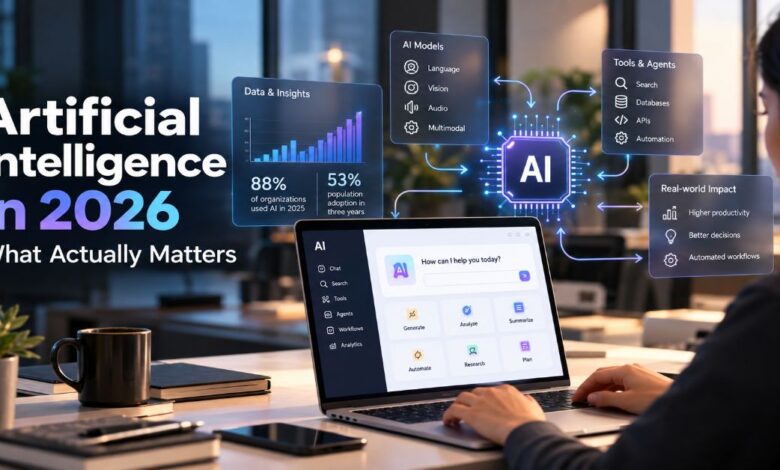
Artificial Intelligence is the broad field of computer systems that infer, predict, generate, decide, or act toward human-defined goals; in 2026, the important change is that those systems are moving from isolated features into workflows that can perform multi-step work. That shift is already visible at scale: Stanford’s 2026 AI Index reports that 88% of surveyed organizations used AI in at least one business function in 2025, while generative AI reached 53% population adoption within three years. Stanford HAI’s 2026 AI Index also shows why the story is no longer just about chatbots: technical capability, investment, consumer use, automation, and infrastructure are all rising at once.
The label “AI” still creates confusion because it covers very different systems. A fraud model that scores card transactions, a vision model that detects defects, a language model that drafts a contract, and an agent that can call tools and update a business system all belong to the same broad field, but they fail in different ways and require different controls.
This guide separates those layers. It explains what AI actually does, how machine learning and generative models fit together, why agents are different from ordinary chatbots, where adoption is producing measurable gains, what costs are easy to overlook, and why regulation and energy are becoming part of the technical conversation. The goal is not to predict a science-fiction endpoint. It is to give a clear map of the systems that already exist and the decisions they force in 2026.
What Artificial Intelligence Means in 2026
A useful modern definition focuses on inference rather than imitation. The OECD describes an AI system as a machine-based system that, for explicit or implicit objectives, infers from input how to generate outputs such as predictions, content, recommendations, or decisions that can influence physical or virtual environments. That framing matters because it covers both older predictive systems and newer generative or agentic systems without pretending they “think” exactly like people.
Most deployed AI remains narrow: it performs particular classes of tasks under defined conditions. “General AI” or AGI refers to a much broader hypothetical capability and should not be confused with today’s general-purpose models, which can handle many tasks but still show uneven reliability, weak grounding, and context sensitivity.
The four layers people often collapse into one
| Layer | What it does | Typical failure mode |
| Model | Maps inputs to predictions, scores, text, images, code, or actions | Wrong, biased, unstable, or poorly calibrated output |
| Application | Adds prompts, retrieval, memory, tools, interfaces, and permissions | Bad context, weak access control, prompt injection, stale data |
| Workflow | Defines when AI acts, when humans review, and what happens next | Automation of the wrong task or unclear accountability |
| Infrastructure | Provides chips, data centres, networks, storage, and power | Latency, cost, capacity bottlenecks, energy and supply-chain exposure |
This layered view is more useful than asking whether a company “has AI.” A high-performing model can still produce a poor business result if the retrieval layer is stale, the workflow has no approval checkpoint, or the application is allowed to write into a critical system without adequate permissions.
How Modern AI Produces an Answer or Action
Traditional software follows explicit instructions written by developers. Machine-learning systems instead learn statistical relationships from data and use those learned relationships to infer an output. Deep learning scales that approach with multilayer neural networks, while foundation models are trained broadly enough to be adapted across many downstream tasks.
From training to inference
Training adjusts model parameters so the system becomes better at producing desired outputs from examples. Inference is the runtime stage: a trained model receives a new input and generates a prediction or response. For large language models, that response is built token by token from probability distributions conditioned on the prompt and context. The result can look deliberate even though the underlying mechanism is statistical rather than a guarantee of factual truth.
Why retrieval, tools, and agents matter
A base model only knows what is encoded in its training and what appears in its current context. Retrieval-augmented generation can inject relevant documents at runtime. Tool use goes further by letting a model call a calculator, database, search system, code environment, or business API. An agent adds a control loop: plan, act, inspect the result, and continue until a stopping condition is reached.
That increases usefulness, but it also increases the blast radius of mistakes. A chatbot that invents a number may waste a few minutes; an agent with permission to send messages, modify records, or execute code can turn the same reasoning error into an operational incident. Capability therefore has to be matched with permissions and review.
The 2026 Reality: Adoption Is High, Autonomy Is Not
The headline adoption number can be misleading if it is read as proof that AI has become deeply autonomous. Stanford’s economy chapter reports 88% organizational AI use and 79% regular generative-AI use in at least one function in 2025. Yet AI-agent deployment remained in the single digits across nearly all business functions. The gap is revealing: companies are comfortable adding AI assistance faster than they are comfortable delegating end-to-end responsibility.
| Signal | 2025–26 evidence | What it actually suggests |
| Organizational adoption | 88% use AI in at least one function | AI is mainstream inside organizations, but depth varies |
| Generative-AI use | 79% report regular use in at least one function | Text/code/content assistance is widespread |
| Agent deployment | Single digits across nearly all functions | Autonomous workflows are still early |
| Consumer adoption | 53% within three years | Diffusion is fast, but uneven by country and income |
| Frontier benchmark gains | SWE-bench Verified rose from 60% to near 100% in one year | Capability is moving quickly; benchmark saturation is a measurement problem |
This also explains why some AI programs disappoint after impressive demos. A demo optimizes for a clean task and a visible answer. Production has messy data, exceptions, permissions, handoffs, latency targets, logging, compliance, and people who need to trust the output. The model is only one component of the deployed system.
Where AI Creates Measurable Value
The best current use cases share a common property: the work can be checked. When outputs are measurable, teams can compare AI-assisted performance with a baseline, detect failure, and decide whether human review is still needed. The 2026 AI Index cites productivity gains around 14–15% in customer support, 26% in software development, and 50% in marketing output in selected studies. Those figures should not be generalized to every organization, but they point to the kind of work where feedback is fast and quality can be observed.
High-value patterns
- Summarization and extraction: turning long documents, calls, tickets, or reports into structured fields that a person can verify.
- Coding assistance: generating boilerplate, tests, migrations, explanations, and candidate fixes inside a reviewable engineering process.
- Decision support: ranking options, identifying anomalies, forecasting demand, or surfacing evidence while leaving consequential decisions to accountable humans.
- Content transformation: translating, adapting, tagging, or repackaging material where the source and desired output are known.
- Workflow triage: routing cases, prioritizing queues, and preparing next-step suggestions before a human commits the action.
The weakest candidates are tasks where success is subjective, feedback arrives slowly, errors are hard to detect, or a plausible-sounding mistake can cause legal, financial, medical, or safety harm. In those settings, automation may still help, but evaluation and review must be designed before scale.
The Reliability Problem Is a Workflow Problem Too
Generative systems can produce false statements, fabricated citations, insecure code, biased recommendations, or inconsistent answers. NIST’s Generative AI Profile treats these as risk-management problems across the AI lifecycle rather than defects that can be solved by prompting alone. That is the right frame: reliability depends on data provenance, evaluation, access control, monitoring, escalation, and the consequences attached to each output.
Three controls that matter more than a clever prompt
- Evaluation sets built from real tasks. A model should be tested against representative inputs, edge cases, and failure modes before rollout, not judged by a handful of impressive examples.
- Permission boundaries. Systems should receive only the tools and data they need. Read access, draft access, and irreversible write access are different risk levels.
- Human review tied to consequence. Review should be strongest where an error is difficult to reverse or expensive to discover later.
A useful operational metric is not “accuracy” in isolation but expected loss: how often an error occurs multiplied by how costly that error is. A system that is 99% reliable can still be unacceptable if the remaining 1% can transfer money, expose sensitive data, or deny a person an important service.
Compute, Energy, and the Cost Behind the Interface
AI often feels weightless because the user sees a text box. The physical layer is anything but weightless. Training and inference run in data centres packed with servers and specialized accelerators, supported by networking, cooling, storage, and large power systems. The International Energy Agency estimates that servers account for roughly 60% of electricity demand in modern data centres, although the share varies by facility type.
The larger point is directional: AI scale is becoming an infrastructure constraint. The IEA projects global electricity generation used to supply data centres to grow from about 460 TWh in 2024 to more than 1,000 TWh in 2030 in its base case. Model efficiency is improving, but falling cost can also increase demand because more applications become economical.
The hidden cost calculation
For a business, the relevant cost is not just price per token or subscription per seat. A serious deployment may also include retrieval infrastructure, model routing, observability, security review, human quality checks, vendor management, and rework when outputs fail. A cheaper model can therefore be more expensive if it needs materially more review or produces more downstream correction.
Governance Is Moving Into Product Design
Regulation is no longer a distant variable. The European Commission’s AI Act guidance states that the Act entered into force on August 1, 2024 and became broadly applicable on August 2, 2026, with staged dates for specific high-risk provisions. Transparency rules now require certain AI systems to disclose AI interaction and require labeling or machine-readable marking in defined synthetic-content contexts.
Even organizations outside the EU should pay attention because governance requirements often become product requirements: logging, documentation, model inventories, disclosure, incident handling, data controls, and evidence that human oversight exists where promised. These controls are easier to design into a system than bolt on after deployment.
The most important distinction: assistance versus delegation
The more authority a system receives, the more governance must move upstream. Drafting a recommendation is different from approving a claim. Suggesting a software patch is different from deploying it. Preparing a customer response is different from sending it. This distinction gives teams a practical way to scale AI without pretending every task deserves the same autonomy level.
What the Top Explainers Commonly Miss
Most high-ranking AI guides correctly cover definitions, machine learning, deep learning, generative AI, use cases, benefits, and risks. Three less obvious points deserve more emphasis.
1. Model choice is becoming less important than system design
As top models converge on many public benchmarks, differences in cost, latency, privacy, tool support, context handling, reliability, and integration become more important. A slightly weaker model inside a disciplined workflow can outperform a stronger model connected to poor data with no evaluation.
2. The bottleneck is shifting from generation to verification
Generating a draft is cheap. Establishing that the draft is correct, safe, current, and appropriate for a real decision is the harder step. This is why retrieval, citations, constrained outputs, deterministic checks, and human escalation are becoming core product features rather than optional polish.
3. AI economics are partly about error budgets
The right automation threshold depends on consequence. If a task can tolerate frequent low-cost corrections, aggressive automation may make sense. If one hidden error can create a large loss, the system needs stronger verification even when the model looks highly capable. This reframes ROI from “minutes saved” to “verified useful output per dollar and per unit of risk.”
The Future of Artificial Intelligence in 2027
The most defensible 2027 trend is not a single prediction about AGI. It is a continuation of three observable shifts: more tool-using systems, more efficient model deployment, and more formal accountability around how AI is used.
Agents will likely move beyond pilots where tasks are bounded, permissions are narrow, and success can be measured. The limiting factor will be less whether a model can produce a plan and more whether organizations can make execution safe enough to trust. Expect more systems that combine multiple models, retrieval sources, deterministic software, and approval gates rather than one model handling everything.
Infrastructure pressure will remain visible. Power availability, data-centre buildout, chips, networking, and model efficiency are all part of the cost curve. At the same time, regulation is becoming more operational: the EU AI Act’s staged high-risk requirements continue into 2027 and 2028, while NIST is revising its AI Risk Management Framework. The uncertainty lies in pace. Capability can change faster than procurement, policy, education, and grid infrastructure, so the gap between what is technically possible and what can be responsibly deployed may widen before it narrows.
Key Takeaways
- AI is a family of inference systems, not a synonym for chatbots or human-like intelligence.
- In production, application design, data quality, permissions, evaluation, and workflow controls can matter as much as raw model capability.
- Adoption is already mainstream, but autonomous agent deployment remains early, which shows where organizational trust currently stops.
- The easiest AI wins are tasks with fast feedback, observable quality, and reversible errors.
- Infrastructure and electricity are part of AI economics; the interface hides a large physical system.
- Governance is becoming a design constraint, especially when AI interacts with people, regulated decisions, or synthetic media.
- The strongest 2027 strategy is not maximum automation. It is selective delegation with measurable performance and explicit accountability.
Conclusion
Artificial intelligence has become easier to access and harder to evaluate. The models are more capable, the interfaces are simpler, and adoption is faster, but that convenience can hide the real work: choosing the right task, providing reliable context, controlling permissions, measuring failure, and deciding when a human must remain accountable.
That is why the most useful distinction in 2026 is not “AI versus no AI.” It is assistance versus delegation. AI can already accelerate research, coding, support, analysis, and content workflows, yet the value of those systems depends on how cheaply and reliably their output can be verified. As adoption moves toward agents and deeper automation, the organizations that benefit most are likely to be the ones that treat AI as an engineered system with costs, controls, and failure modes—not as a magic layer placed on top of every process.
Frequently Asked Questions
What is artificial intelligence in simple terms?
Artificial intelligence is software or a machine-based system that infers an output from inputs in order to pursue a human-defined objective. The output may be a prediction, recommendation, decision, generated text or image, or an action. Modern AI includes machine learning, computer vision, language systems, generative models, and tool-using agents.
Is artificial intelligence the same as machine learning?
No. AI is the broader field. Machine learning is one major approach within AI in which systems learn patterns from data instead of relying only on rules written by programmers. Deep learning is a subset of machine learning that uses multilayer neural networks. Generative AI is an application class that creates new content from learned patterns.
What is the difference between generative AI and an AI agent?
Generative AI produces content such as text, code, images, audio, or video. An AI agent adds a loop around a model so it can plan, call tools, inspect results, and continue toward a goal. Agents can therefore affect external systems, which makes permissions, monitoring, and stopping rules more important.
Why does AI hallucinate?
Generative models are optimized to produce likely outputs from patterns in data, not to guarantee that every statement is true. When context is missing, ambiguous, or outside reliable knowledge, a model can generate a fluent but false answer. Retrieval, constrained data sources, deterministic checks, and human verification can reduce the risk but not eliminate it.
Will AI replace jobs?
The evidence is mixed and task-specific. Current research shows productivity gains in some structured occupations and early pressure on some entry-level pipelines, while economy-wide job loss has not appeared at the scale implied by the strongest claims. AI is more likely to change task composition unevenly than affect every occupation in the same way.
How much electricity does AI use?
There is no single per-query figure that applies to all AI because energy use varies by model, hardware, data-centre efficiency, workload, and location. The clearer signal is system-wide: data-centre electricity demand is rising quickly, and the IEA projects global electricity supply for data centres to exceed 1,000 TWh by 2030 in its base case.
What should a business evaluate before deploying AI?
Start with the task and the cost of error. Define a measurable baseline, test representative cases, decide what data the system can access, limit permissions, establish human review for consequential actions, monitor failures, and calculate total operating cost including verification. Model selection should come after those requirements are clear.
Methodology
This article was researched on October 1, 2026. The SERP review examined current high-visibility pages for “artificial intelligence,” “what is artificial intelligence,” and related guide intent, including Wikipedia, NASA, Google Cloud, IBM, Intel, Built In, Gartner, Stanford HAI, Australia’s National AI Centre, and Cloudflare. Their structures were used only to identify recurring coverage and gaps; the article structure was developed independently.
Factual validation prioritized primary or institutional sources: the OECD for the updated AI-system definition, Stanford HAI for 2026 capability and adoption data, NIST for generative-AI risk management, the European Commission for AI Act implementation dates, and the International Energy Agency for data-centre electricity analysis. Survey-based adoption statistics are directional and depend on respondent populations; benchmark results do not guarantee production performance; energy forecasts are scenario-based and may change with efficiency, demand, and infrastructure investment.
References
International Energy Agency. (2025). Energy and AI. IEA.
National Institute of Standards and Technology. (2024, updated 2026). Artificial Intelligence Risk Management Framework: Generative Artificial Intelligence Profile (NIST AI 600-1).
Organisation for Economic Co-operation and Development. (2024). Explanatory memorandum on the updated OECD definition of an AI system. OECD Artificial Intelligence Papers, No. 8.
Stanford Institute for Human-Centered Artificial Intelligence. (2026). The 2026 AI Index Report.
European Commission. (2026). AI Act: Regulatory framework for artificial intelligence.