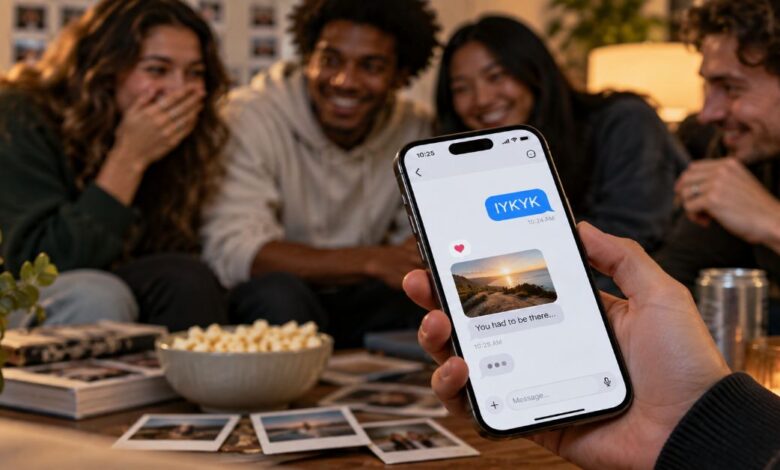
IYKYK means “if you know, you know”: online, it signals that a joke, memory, place, feeling, or reference is meant to be understood by people who already share the context, while everyone else is left without the full explanation on purpose. The iykyk meaning is therefore more than a dictionary definition. It is a small social filter packed into five letters.
That is why the phrase can look oddly empty to a newcomer. The words do not supply the missing information; they announce that the missing information matters. A blurry photo from a familiar restaurant, a one-line comment about a difficult commute, or a reference to a fandom moment can all carry “IYKYK” because the author expects a specific audience to fill in the blanks.
Cambridge Dictionary defines IYKYK as a written abbreviation for “if you know you know,” used in social media and text messages for shared jokes or knowledge. That captures the surface meaning. The better question is what the phrase does between people. It can create warmth and belonging. It can also create distance. The same shorthand that makes one friend feel seen can make another reader feel intentionally outside the circle.
This guide separates those layers. It explains what IYKYK signals, how the tone changes in texts and captions, where the online form came from, how it differs from similar phrases, when it sounds natural, and when it is better to say what you actually mean.
What IYKYK Actually Signals
IYKYK is an initialism: each letter represents a word in “if you know, you know.” In everyday writing, people also call it an acronym or abbreviation, and major dictionaries treat it as internet and texting shorthand. The useful point is social, not grammatical. IYKYK rarely carries the whole message by itself. It points backward to a clue that only some readers can decode.
That clue may be private, such as a memory from a group chat. It may be public but niche, such as a line from a show, a local landmark, a sports reference or a recurring workplace problem. It may even be a common experience that feels specific: parents seeing a particular mess, commuters recognizing a station delay, or gamers remembering a notoriously difficult level.
The phrase works because the writer does not have to name the group. The reference does that work. People who understand it recognize themselves as the intended audience.
The shorthand can perform several jobs at once:
| Signal | What it communicates | Typical example |
| Inside joke | Only people with the backstory will fully understand. | “The red chair again. IYKYK.” |
| Shared experience | People who have lived this situation will recognize it. | “Monday train at 8:10. IYKYK.” |
| Niche knowledge | The reference belongs to a fandom, place or community. | “Episode 6 changed everything. IYKYK.” |
| Soft secrecy | The writer hints at a story without publishing the details. | “That reunion was… something. IYKYK.” |
Why the Missing Explanation Is the Point
A normal explanation removes doubt. IYKYK keeps some doubt in place. That is what makes the phrase useful.
In conversation, people constantly rely on shared context: names they do not need to define, memories they do not need to retell, and jokes that would become less funny if every detail had to be explained. IYKYK turns that habit into a clear signal. It says, in effect, “the people this is for already have enough information.”
That makes it a context gate, not a secret code. A secret code hides content by changing it. IYKYK usually leaves the content in plain sight but withholds the background needed to appreciate it. A photo of an empty paper bag can mean nothing to most people and everything to a friend who remembers what happened the night that bag became a joke.
This also shows why a long explanation after IYKYK can feel awkward. If the writer immediately adds a long explanation, the phrase loses its job. The signal only works when some of the meaning remains unstated.
How the Meaning Changes by Context
The core meaning stays the same, but the tone depends on where the phrase appears and who sees it. In a private chat, it often feels intimate. In a public caption, it can be a way to invite the “right” audience to recognize itself. In a comment, it can function as agreement without repeating the whole reference.
Tone also comes from the material around it. “That parking lot after 6 p.m. … IYKYK” sounds like shared frustration. “Best table in the city, IYKYK” sounds like insider knowledge. A photo with no explanation can make the phrase feel more mysterious because the visual carries the clue.
Pew Research Center’s 2026 study of U.S. teens found that TikTok, Instagram and Snapchat remain major places for entertainment, connection and interest-based interaction. Those are good conditions for short in-group signals. People are not only speaking to everyone. They are also speaking to smaller groups inside the same public feed.
Context changes the emotional reading more than the literal definition:
| Setting | Likely tone | What the reader should infer |
| Private text | Personal, intimate or funny | There is probably shared history behind the line. |
| Group chat | Collective memory or callback | The message is for members who remember the same event. |
| Instagram caption | Curated mystery or local knowledge | The post offers a clue and lets familiar followers complete it. |
| TikTok comment | Community recognition | The commenter is signaling membership in the audience that gets the reference. |
| Work chat | Can be playful, but risky | If context affects the task, it should be explained rather than withheld. |
The Tone Problem: A Wink Can Also Be a Wall
IYKYK often feels friendly because it rewards people who get the reference. But the same mechanism can turn exclusionary when the audience is mixed. A team chat that repeatedly uses unexplained inside references may make newer colleagues feel shut out. A caption aimed at one small group can make other followers feel teased for not knowing enough.
That does not make the phrase rude by default. Tone depends on the stakes. In casual social posts, a little mystery is often the point. In instructions, work updates, health information, school communication or anything where misunderstanding has a cost, clarity should win.
There is also a gap between a playful hint and vague bait. “IYKYK” can be used to imply scandal, gossip or secret knowledge without providing evidence. Readers should not treat the phrase as proof that a hidden claim is true. Sometimes it is simply a joke. Sometimes it is bait.
Where IYKYK Came From — and Why the Dates Need Care
The full phrase “if you know, you know” is older than social media, so there is no credible case that internet users invented the underlying expression. The harder question is when the short form IYKYK became visible online.
Dictionary.com reports that the abbreviation has appeared on social media since at least 2009 and grew during the mid-2010s. Know Your Meme points to a December 4, 2016 Urban Dictionary definition as an early, easy-to-check user dictionary entry. These two facts do not have to conflict. One is a claim about earlier usage; the other is a dated surviving entry that can be checked directly.
The phrase got another cultural boost in 2018 when Pusha T released “If You Know You Know” on the album Daytona. In an interview about the track, he described it as speaking to a core audience that already understood the references. That shows the phrase at work. Its value comes from knowing what is left unsaid.
By 2019 and 2020, the hashtag form was common enough on Twitter, Instagram and TikTok to be documented as a meme and caption convention. One song or one platform did not give the phrase its meaning. It became easy to reuse. It was short enough for captions, loose enough for jokes, and broad enough for many groups.
IYKYK vs Similar Phrases
Several phrases overlap with IYKYK, but they are not the same. The difference is mostly about where the shared knowledge comes from and how much the speaker wants to explain.
| Phrase | Core idea | How it differs from IYKYK |
| “You had to be there” | The experience cannot be fully recreated later. | Focuses on attendance at a past moment. |
| “Inside joke” | A joke belongs to a specific group. | Names the social category instead of performing it. |
| “No context” | A post is intentionally shown without explanation. | Highlights missing context rather than shared knowledge. |
| “If you get it, you get it” | Recognition cannot be forced. | Very close in function, but less fixed as a social-media initialism. |
| “IYKYK” | The intended audience already knows enough. | Combines recognition, omission and in-group signaling in a compact tag. |
How to Use IYKYK Without Sounding Forced
The best use comes after a clue that is clear to the intended group but incomplete for everyone else. “The third-floor vending machine after midnight. IYKYK.” The phrase works because a certain group can supply the story.
It is weaker when attached to a statement that needs no hidden context. “Coffee is good, IYKYK” usually sounds forced because there is no clear insider layer. The same problem appears when brands use the phrase without a real group reference. The copy can feel like an attempt to fake belonging.
If someone sends IYKYK and you understand, a short reply is usually enough: “Exactly,” “Say no more,” a relevant emoji, or a callback to the shared reference. If you do not understand and the relationship allows it, asking “Okay, what am I missing?” is perfectly normal. The phrase invites people to get the reference. It does not ban others from asking.
What Not to Assume When Someone Sends It
IYKYK is not always flirty, romantic, sarcastic or secretive. Any of those tones are possible, but they come from the surrounding message. A partner can use it for a shared memory; coworkers can use it for a recurring problem; fans can use it for a niche reference; friends can use it for something embarrassing that they do not want to explain publicly.
It is also not inherently Gen Z-only. Younger users helped normalize many compact social-media expressions, but the phrase now appears across age groups because the basic habit is common: people like short forms that reward shared experience. Pew’s 2025 U.S. adult survey found that Instagram and TikTok use remained especially high among adults under 30, while both platforms also reached substantial shares of older adults. The language around them can spread beyond one generation.
The Future of IYKYK in 2027
IYKYK is unlikely to disappear simply because a newer slang term arrives. It solves a lasting problem: how to point at shared context without saying it all again. As long as people move between public feeds, private chats, fandoms and local groups, short markers will have value. They help separate “people who get this” from everyone else.
The form may become less novel, though. Once slang is in dictionaries, used by brands and known by parents, it loses some of its fresh insider feel. That does not necessarily kill the term. It can shift from trend to normal shorthand, much as “LOL” became routine online language.
Platform behavior also favors persistence. Pew’s 2026 teen research shows that TikTok, Instagram and Snapchat are still heavily used for entertainment, friendship and interest-based connection, while its 2025 adult research found growth in Instagram, TikTok, WhatsApp and Reddit compared with 2021. Those networks create many small groups with their own references. The exact slang will change. The need for shared-context signals will stay.
Key Takeaways
- IYKYK is best read as a signal of shared context, not just a compressed sentence.
- The phrase is an initialism for “if you know, you know,” and it usually follows a clue rather than replacing the whole message.
- Its tone depends on relationship and stakes: intimate among friends, playful in captions, and potentially excluding in mixed groups.
- Online-origin dates should be handled carefully: reported use since 2009 and a verifiable 2016 Urban Dictionary entry describe different evidence.
- Pusha T’s 2018 song amplified a phrase that already existed; it did not create the expression.
- The most natural use leaves enough context for insiders to recognize the reference without forcing outsiders to decode it.
- When clarity matters more than belonging or mystery, spelling out the context is the better choice.
Conclusion
The simplest definition of IYKYK is also accurate: “if you know, you know.” What makes the phrase interesting is everything that definition leaves out. It turns shared context into part of the message, allowing a writer to recognize an audience without naming it and to preserve a joke, memory or reference without flattening it through explanation.
That is why the phrase can feel unusually efficient. Five letters can carry nostalgia, agreement, embarrassment, insider knowledge or gentle teasing, depending on what comes before them. The trade-off is equally clear: the stronger the in-group signal, the more visible the out-group can become.
For most casual uses, the rule is simple. Use IYKYK when there is genuinely something for the intended audience to recognize. Do not use it as a substitute for information people actually need. The phrase works best when the missing explanation is part of the meaning, not when the missing explanation creates avoidable confusion.
Frequently Asked Questions
What does IYKYK mean in text?
IYKYK means “if you know, you know.” In a text message, it usually points to an inside joke, shared memory or situation that the sender expects the recipient to understand without a full explanation.
What does IYKYK mean on TikTok and Instagram?
On TikTok and Instagram, IYKYK often appears in captions, comments and hashtags to flag a niche reference or relatable experience. The post may make complete sense only to followers who know the place, fandom, event, trend or backstory.
Is IYKYK flirty?
It can be, but it is not inherently flirty. If two people share a romantic memory or private joke, IYKYK can sound intimate. In other settings it can be funny, nostalgic, sarcastic or simply referential. The surrounding message determines the tone.
Is IYKYK rude or exclusionary?
Not by default. It often creates a playful sense of belonging. It can feel exclusionary when it is used repeatedly in mixed groups, especially when newcomers need the missing context to participate. Stakes and audience matter more than the letters themselves.
How do you reply to IYKYK?
If you understand the reference, a short acknowledgment such as “Exactly,” “Say no more,” or a callback to the joke is enough. If you do not understand, asking what you missed is normal unless the context is obviously private.
Is IYKYK an acronym or an initialism?
Technically, IYKYK is usually treated as an initialism because people commonly read the letters or expand them to the full phrase rather than pronounce them as a new word. In casual usage, “abbreviation” or even “acronym” is also common.
What does IYKYK mean in simple words?
In simple words, IYKYK means: “People who share the context will understand this without an explanation.” It points to inside knowledge, a shared experience or a reference meant for a certain group.
Methodology
This article was built from dictionary definitions, dated internet-culture records, a verifiable early user-generated dictionary entry, an official 2018 music release, and current Pew Research Center data on social-platform use. The top-ranking search results for the focus query were also reviewed to identify repeated coverage and missing angles; their structure was not copied.
The strongest source agreement is on the core definition and common use: IYKYK means “if you know, you know” and marks shared knowledge or an inside reference. Origin dating is less certain. Dictionary.com reports use since at least 2009, while Urban Dictionary provides a directly checkable 2016 entry and Know Your Meme documents later spread. The article therefore avoids presenting one date as a proven first use.
No relevant live FishAudios article could be verified through web search, and the site sitemap was not retrievable through the available research tools. Rather than force unrelated internal links, this draft includes none; internal linking should expand when a genuinely relevant published page can be verified.
Publishing disclosure to retain only after the stated human review has actually occurred: “This article was drafted with AI assistance and reviewed by a human editor before publishing. All data, citations, and claims have been independently verified against primary sources.”
References
Cambridge Dictionary. (n.d.). IYKYK. Cambridge University Press.
Dictionary.com. (2022, November 7). iykyk.
Know Your Meme. (2020). IYKYK.
Urban Dictionary. (2016, December 4). IYKYK.
Pew Research Center. (2025, November 20). Americans’ social media use 2025.
Pew Research Center. (2026, April 15). Teens’ experiences on TikTok, Instagram and Snapchat.
Pusha T. (2018, June 19). If You Know You Know (Official Video) [Video]. YouTube.
Pitchfork. (2018). Pusha-T breaks down every song on his new album, Daytona.